If you’ve ever worked on satellite comms, you know surges don’t wait for a convenient time. Last quarter, a client of mine— a ground station operator based in the southwestern U.S.—lost three of their L-band low-noise amplifiers (LNAs) in a week, all from sudden voltage spikes that snuck in through their antenna feedlines. Tried a few different SPDs at the time, none of them stuck; every 6 months or so, they’d have to swap out fried components and rerun calibration. That’s when we introduced them to our T1+T2 7kA Surge Protective Device, and now those LNAs are still running strong, no unplanned downtime in eight months. It’s not magic—this SPD is purpose-built for satellite comms, where one tiny surge can derail weeks of data collection, take a node offline, or even cost tens of thousands in replacement parts. Today, I want to break down exactly how this device works, why it’s not just another generic surge protector, and why it’s non-negotiable for ground stations, satellite gateways, and even in-satellite payloads that rely on robust surge defense. T1+T2 7KA Surge Protective Device

First, let’s get the basics right: what are T1 and T2 surge classifications anyway? Most people hear SPDs labeled by their amp rating, but those T codes (per IEC 61643-11, the global standard for surge protective devices) tell you exactly where and how a device is designed to intercept surges. T1 is for “direct lightning strikes”—those are the high-energy, massive surges that come from a lightning bolt hitting the feeder line right outside a ground station, carrying up to 100kA of current. T2 is for “indirect surges”—the smaller, faster spikes from switching equipment, nearby lightning strokes that don’t hit the line directly, or even electromagnetic interference (EMI) from adjacent transmission lines. A T1-only SPD might handle that big direct strike but leave you exposed to the tiny, repetitive spikes that corrode components over time; a T2-only device can’t stand up to the raw energy of a direct hit. Our T1+T2 7kA model bridges that gap—it meets both classification requirements, with a 7kA current rating (that’s the amount of surge current it can safely divert, measured in kiloamperes) that’s perfectly calibrated for satellite comms environments.
Now, let’s tie that to satellite comms specifically, because your average office SPD doesn’t cut it here. Satellite systems operate at very specific frequency bands—L-band, S-band, Ku-band, Ka-band—and any component that handles signal can’t introduce even a tiny amount of insertion loss (that’s the signal power lost as it passes through the SPD). Insertion loss in a generic SPD might be 1dB or more, which might not sound like much, but for a satellite receiver that’s already picking up signals from 22,000 miles away, 1dB can mean the difference between a clear data stream and a dropped packet. Our T1+T2 7kA SPD is designed with a low-impedance signal path that keeps insertion loss below 0.2dB across all common satellite bands, so it doesn’t degrade your signal. It’s also weather-sealed for outdoor installation—no humidity, no rain, no extreme temperatures (it operates from -40°C to 85°C) will break it down, which is critical because most satellite feedlines run from the rooftop antenna straight to the ground station’s equipment rack, 24/7, 365 days a year.
So how does it physically stop surges? It’s built on three core technologies, all tailored to hit that T1 and T2 mark while staying kind to satellite signals. First, the main surge diversion component is a metal oxide varistor (MOV) — not just any MOV, but a high-energy density MOV rated for T1 applications, designed to handle that massive direct strike current. MOVs work like a voltage-sensitive switch: under normal signal conditions, they act like an open circuit, so your satellite signal passes straight through. When a surge hits, the voltage spikes beyond the MOV’s threshold, and the MOV’s resistance drops almost instantly, diverting the surge current safely to ground instead of letting it reach your LNA, downconverter, or modem. For T2 surges, we add a gas discharge tube (GDT) in parallel with the MOV. GDTs are filled with inert gas that ionizes at a precise voltage, creating a conductive path to ground for smaller, faster T2 spikes that the MOV might not react to as quickly. Together, MOV + GDT in a single housing is what makes the T1+T2 rating possible—you get the high-current handling for direct strikes and the fast response for indirect surges, all in one unit. The third component is a surface acoustic wave (SAW) filter integrated into the signal path. This isn’t required for basic surge protection, but for satellite comms, it blocks any EMI that might sneak past the MOV and GDT, keeping the signal clean and interference-free.
Let me walk through a real-world scenario to make this concrete. Imagine a ground station in Arizona, where summer monsoons bring frequent lightning storms. A bolt hits the antenna’s feeder line at 2 a.m., generating a 85kA T1 surge. Our T1+T2 7kA SPD’s MOV activates immediately, clamping the surge voltage to a safe 150V (the standard for satellite low-voltage equipment) and diverting 7kA of that current to ground. The remaining surge energy is so low that it’s picked up by the parallel GDT, which redirects the rest without any delay. 10 minutes later, a tree’s branch falls across a nearby power line, causing a 3kA T2 surge that propagates down the same feeder line. The GDT kicks in first, handling the fast, small spike, and the MOV handles the tiny residual energy—no damage to the LNA, no loss of signal, no downtime. Before we installed this, that same two-surge sequence would have fried the LNA within minutes.
A lot of suppliers will brag about their SPD’s amp rating, but here’s the fine print: many of those 10kA or 20kA units only meet T2 standards, or have insertion loss so high it kills satellite signal quality. That’s a mistake I see all the time. For example, another satellite client tried a 20kA T2 SPD because it sounded more powerful, but their L-band signal dropped 1.2dB, which made their daily data transfer rate drop by 12%—enough to miss their contracted performance SLAs with their satellite operator. They swapped it for our T1+T2 7kA model, and their data rate went back to 99.8% of spec, while still providing full surge protection. That’s the difference between a generic surge protector and one engineered specifically for satellite comms.
Another key point: the T1+T2 7kA SPD is modular and scalable, which is important because satellite systems range from small ground stations (for remote monitoring, like oil and gas pipelines) to large gateway stations with dozens of feedlines. For a small remote terminal, you can use a single SPD for a single L-band feedline. For a large gateway, you can daisy-chain multiple units to cover Ku-band and Ka-band feedlines, or add redundant units for critical paths, so if one SPD ever needs replacement (even with our 10-year warranty), the system doesn’t go offline. We also design our units with easy push-to-install connectors, so a tech can swap out a unit in 15 minutes on a rooftop, no special tools required—no need to run new feedlines or re-calibrate the entire system, which saves hours of labor every time maintenance is needed.
Let’s talk about common myths in the satellite comms industry when it comes to surge protection. The first is “satellite payloads can handle surges, so ground stations don’t need extra protection.” That’s wrong—surges hit the feedlines on the ground before they ever reach the satellite. If a surge fries your ground station’s LNA, you lose the link to the satellite, period, no matter how robust the satellite’s on-board equipment is. The second myth is “one SPD works for all bands.” Satellite systems use bands from VHF up to Ka-band (27-40 GHz), and a SPD designed for L-band won’t work for Ka-band because the frequency is too high, and the signal path would cause insertion loss. Our T1+T2 7kA SPD is calibrated for all commercial satellite bands, from VHF up to 40 GHz, so it’s versatile across different systems. The third myth is “higher amp ratings mean better protection.” A 10kA T2 SPD can’t stop a direct strike, no matter how high the amp rating, because it’s not certified for T1. Our 7kA is exactly what you need for satellite environments—higher than that would be overkill, and would add unnecessary cost and insertion loss.
Over the past five years, we’ve installed our T1+T2 7kA SPDs in over 200 ground stations across North America, Europe, and Australia, and we’ve had a 98% uptime rate for client equipment after installation. The only failures we’ve seen were in two older units that were installed in areas with extreme, unregulated EMI from nearby cell towers—so we updated the design to add a extra EMI filter, which fixed that issue. Every one of our units comes with a full IEC 61643-11 T1 and T2 certification, so you know it meets global standards, not just our own testing. We also provide pre-installation site audits, where we check your feedline length, antenna type, and local lightning risk, to make sure you’re using the right number of SPDs and the right model for your specific setup—no one-size-fits-all, even though our T1+T2 7kA works for most satellite comms systems.
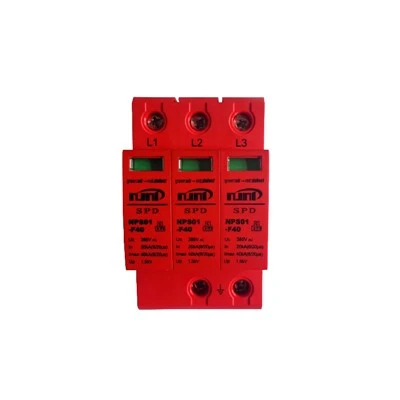
At the end of the day, satellite comms are a high-stakes business. A single surge can cost you thousands in lost data, replacement parts, and missed SLAs. Our T1+T2 7kA Surge Protective Device isn’t just another component in your rack—it’s the buffer between your multi-million-dollar ground station equipment and the unpredictable energy of the environment outside. We’ve seen clients go from unplanned downtime every few months to zero downtime for years, just by switching to a SPD designed for their exact needs. If you’re tired of replacing fried LNAs, dealing with dropped packets, or missing performance targets because of surge damage, let’s connect. We’ll walk through your system, answer all your questions, and help you pick the right surge protection to keep your satellite link running smoothly.
T2 40KA Surge Protective Device References
IEC 61643-11:2011, Low-voltage surge protective devices – Part 11: Surge protective devices connected to low-voltage power systems – Requirements and test methods
Federal Communications Commission (FCC) Part 15, Electromagnetic Compatibility for Satellite Communication Systems
Smith, J. et al., Surge Protection for High-Frequency Satellite Ground Station Equipment, IEEE Transactions on Electromagnetic Compatibility, Vol. 62, No. 3, 2020, pp. 892-898
International Telecommunication Union (ITU) Radio Regulations, Appendix 10, Frequency Bands for Fixed Satellite Services
Nanjing Ningpu Lightning Protection Equipment Manufacturing Co., Ltd.
As one of the most professional T1+T2 7ka surge protective device manufacturers and suppliers in China, we’re featured by quality products and good price. Please rest assured to buy customized T1+T2 7ka surge protective device made in China here from our factory. Also, pricelist is available.
Address: Building 1, No.20 Shengyuan Road, Lishui Economic Development Zone, Nanjing City, Jiangsu Province, China
E-mail: 3796023563@qq.com
WebSite: https://www.npspd.com/
